Rail digitalisation is entering a more commercially relevant phase, with SCI Verkehr arguing that the sector is moving beyond fragmented pilot projects towards solutions that can deliver measurable gains in capacity, efficiency and maintenance.
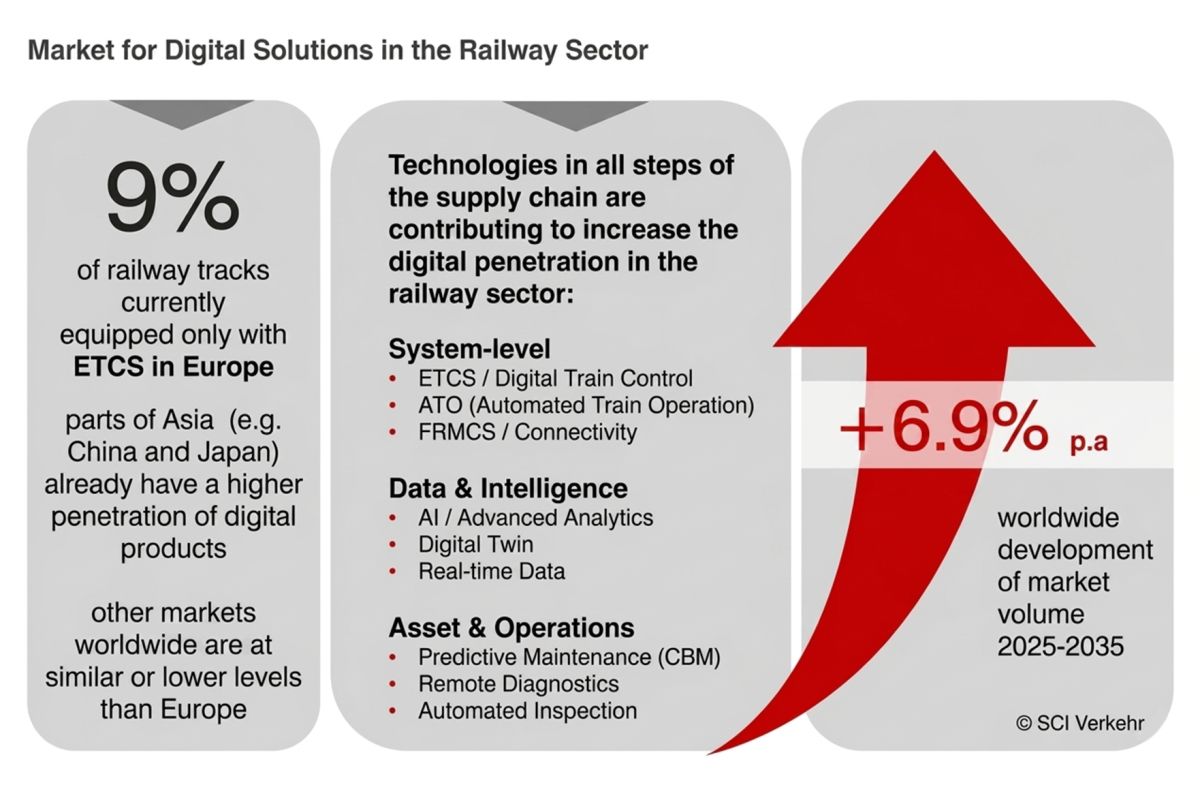
In its new study, “Digital Solutions in the Railway Sector 2026: Market Potential and Outlook,” SCI Verkehr says the global market for rail digital solutions is expected to grow by 6.9% per year between 2025 and 2035. The consultancy also points to major regional differences, with parts of Asia already ahead of Europe in the adoption of digital rail products.
One of the clearest figures in the study is the relatively low current penetration of ETCS in Europe: according to the graphic published with the release, only 9% of railway tracks in Europe are currently equipped with ETCS.
SCI Verkehr groups the current market around three main technology areas: system-level control solutions such as ETCS, digital train control, ATO and FRMCS; data and intelligence tools including AI, analytics, digital twins and real-time data; and asset and operations applications such as predictive maintenance, remote diagnostics and automated inspection.
The company identifies three main conclusions. First, digital solutions are increasingly seen as a way to unlock capacity without relying only on new infrastructure. Second, many rail markets are still at an early stage, held back by fragmented systems, long investment cycles and regulatory complexity. Third, the market is shifting away from standalone tools towards integrated, platform-based solutions linking planning, operations and maintenance.
For the rail sector, the message is straightforward: digitalisation is no longer a side topic, but an increasingly central part of how operators and infrastructure managers will handle rising demand, ageing assets and tighter cost pressure in the years ahead.