Chemet, a company headquartered in Tarnowskie Góry, Poland, has developed a complex, rail-based system for the transport of liquefied carbon dioxide (LCO₂), supported by its own designs for storage tanks and loading infrastructure.
A freight wagon for CO₂
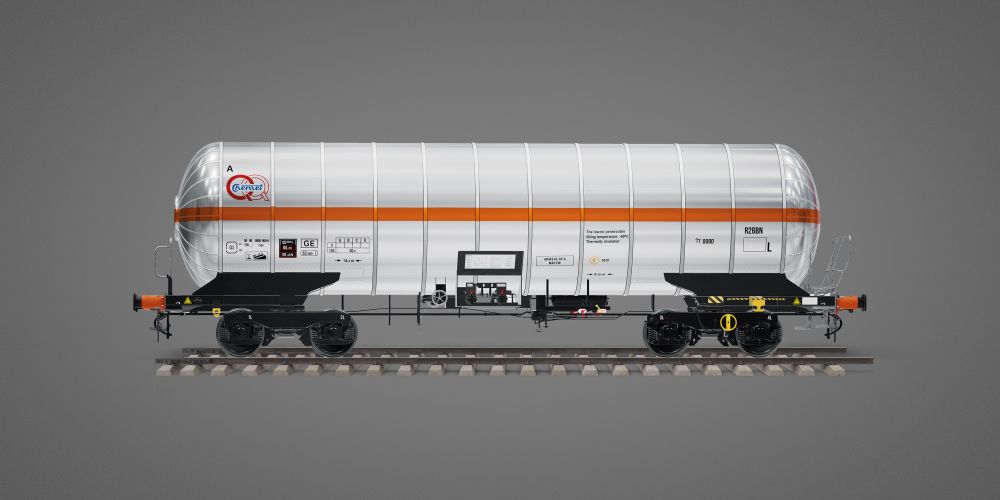
At the core of Chemet’s solution is the new 62 m³ railway tank car for liquid CO₂. The wagon, certified under TSI 321/2013, has a tare weight of around 28 t and a maximum payload of 62 t, giving a total loaded weight of 90 t. It can reach 100 km/h when loaded and 120 km/h when empty.
The tank, built to withstand a test pressure of 2.6 MPa, is insulated with a 200 mm polyurethane layer and clad in stainless steel. It includes hydraulic bottom valves for both gas and liquid phases and a 500 mm manhole for operational access.
A wagon compatible with loading and unloading platforms
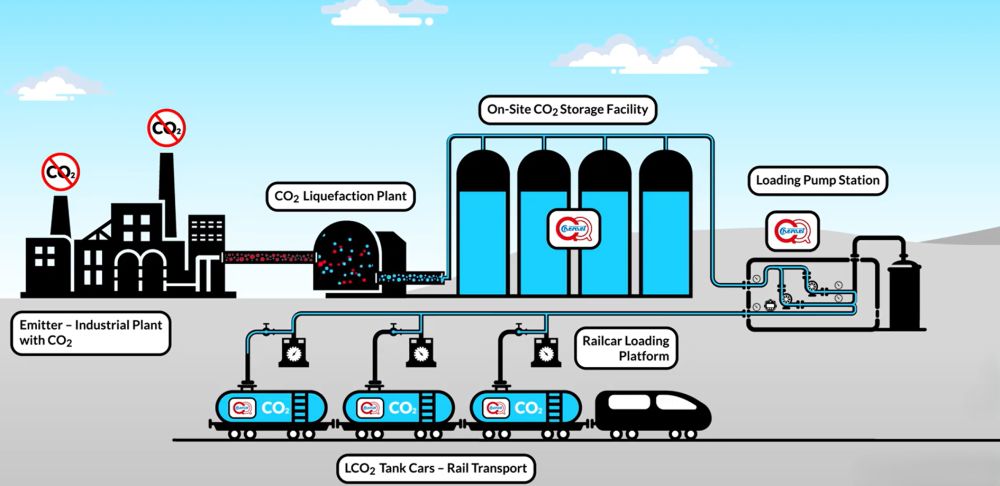
The wagon is designed to be compatible with Chemet’s dedicated rail loading and unloading platforms, allowing for simultaneous filling of multiple wagons. These installations use automated control and measuring systems (MID certified) for precise and safe handling of LCO₂. The company’s pump stations and manifolds are capable of daily long hour operation and modular expansion, enabling adaptation to different industrial sites and capacities.
Part of a broader logistics chain for CO₂
The rail transport with temporary or permanent storage locations offered by Chemet is part of a broader logistics chain that begins with CO₂ capture and liquefaction plants. The system begins at industrial emitters, where the captured gas is liquefied, stored on-site in pressure tanks, and then transported by rail to ports or storage terminals. From there, the liquid CO₂ can be transferred to maritime tankers or injected into geological formations offshore.
In addition to railway tank cars, Chemet also design and manufactures stationary LCO₂ tanks with capacities up to 350 m³, operating at pressures around 20 bar. These are produced according to PED 2014/68/EU, AD 2000, or EN 13445 standards and can be installed horizontally or vertically. The tanks form part of the same modular system as the railway tank cars, ensuring compatibility across the entire transport and storage process.
By combining its experience in pressure vessel engineering with its rail wagon manufacturing capability, Chemet positions itself as a European supplier offering connected solutions for the safe, rail-based transport and storage of CO₂ within industrial CCS networks.